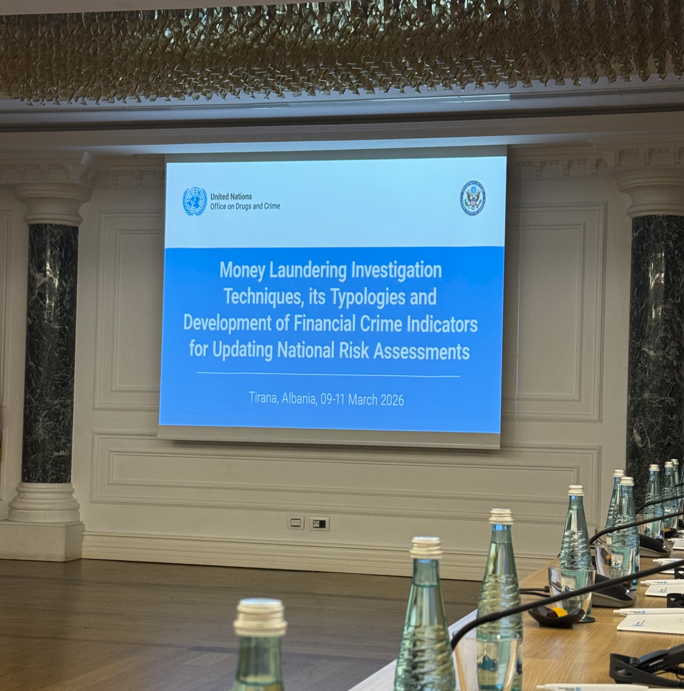
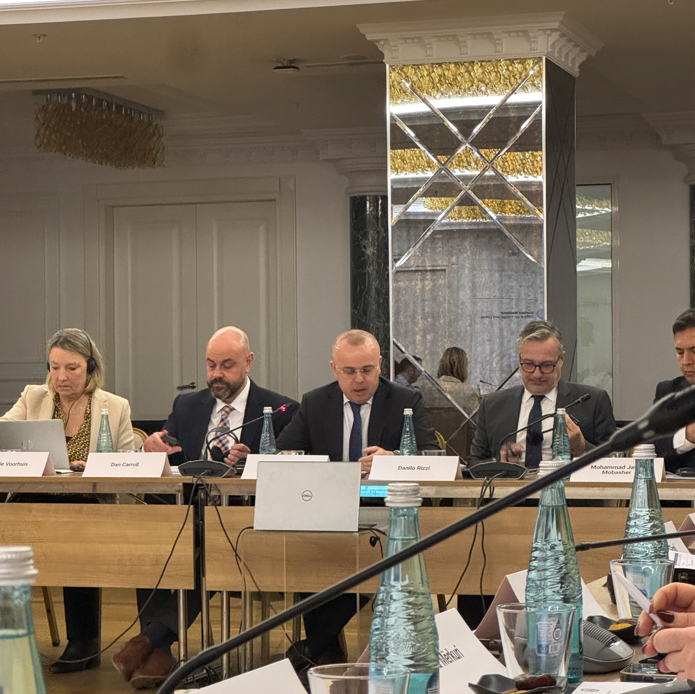
On March 9–11, FIA participated in a training organized by UNODC on the topic “Techniques for Investigating Money Laundering, Its Typologies, and the Development of Financial Crime Indicators for Updating National Risk Assessments.” This training was conducted with the support of the Embassy of the United States of America in Albania, through the Bureau of International Narcotics and Law Enforcement Affairs (INL), with the participation of representatives from the U.S. Embassy in Albania.
Representatives from the General Directorate of State Police, the General Directorate of Taxation, SPAK, the Court of First Instance of General Jurisdiction in Tirana, and the High Judicial Council (HJC) took part in this activity, reflecting a coordinated inter-institutional approach in the fight against terrorism financing and money laundering.
The meeting was opened with remarks by the UNODC Regional Representative, Mr. Danilo Rizzi, and the General Director of AIF, Mr. Ervin Koçi, who emphasized the importance of strengthening investigative capacities, analyzing typologies, and using financial tools to identify suspicious activities.
As part of the training, the following topics were addressed:
- Basic principles of money laundering (ML) investigations and their framework in the context of Albania.
- Sources of investigative data and evidence development, including the use of financial and institutional information.
- Analysis of money laundering typologies and their link to concrete risk and suspicion indicators.
- Money laundering typologies relevant to Albania and the use of advanced investigation and monitoring techniques.
- Use of financial analysis tools to identify suspicious transactions and activities.
- Strategic use of prosecution outcomes to update and improve the National Risk Assessment.
Strengthening investigative techniques, analyzing money laundering typologies, and developing financial crime indicators are essential elements for updating and improving the National Risk Assessment and for increasing the effectiveness of the fight against financial crime.